
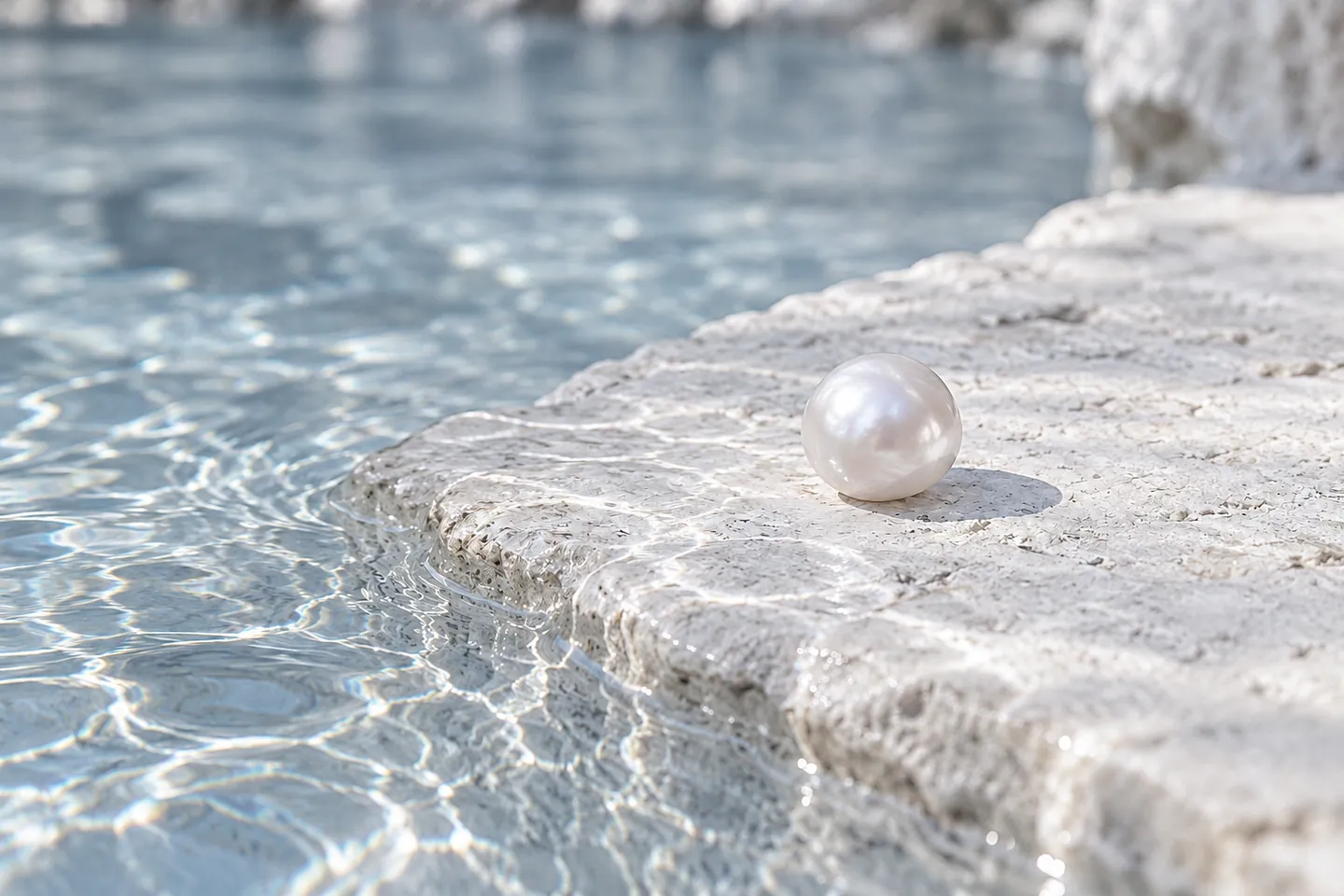
The Pearl Journey
A little wonder.
A long way home.
From the first stirrings of life to the piece you reach for every day. Follow the remarkable journey of a freshwater pearl.
Follow the journeyNature, time & human hands · A 4-minute read
The first chapter / In the water
Before the pearl,
there is a living world.
A pearl does not hatch from an egg. A mussel does. Its early life is a remarkable story of its own—long before pearl cultivation begins.
Life, before luster.
After fertilization, embryos develop within the female mussel. They become tiny larvae called glochidia: the first stage of an animal that may one day grow pearls.
A little help from a fish.
In a typical breeding cycle, larvae attach to a suitable host fish, often at the gills. There they develop before detaching as young mussels and beginning independent life.
It is a small, easily overlooked connection behind something we wear.
Care begins long before
the pearl.
Young mussels are reared and grown until suitable for pearl cultivation. Farmers manage water conditions and the animals’ health; growth depends on the species and environment.
The second chapter / In human hands
Nature makes the pearl.
People help it begin.
Cultured pearls grow inside living mollusks. A careful intervention starts the process. Biology and time do the extraordinary part.
Non-bead-cultured: donor mantle tissue helps form a pearl sac. No solid shell bead is inserted.
The start of a pearl.
In tissue-only freshwater cultivation, a small piece of donor mantle tissue is implanted. It helps establish the pearl sac, whose cells secrete pearl material.
Some freshwater pearls are bead-cultured: a shell bead is implanted along with donor tissue. Both are cultured pearls.
Read the science behind the story ↗Time becomes texture.
Then light.
The pearl sac deposits nacre—layers of mineral crystals and organic material. As those layers build, a pearl develops its surface, form and characteristic luster.
Growth is measured in seasons and years, with timing varying by method, conditions and the intended pearl. There is no single clock for every pearl.
No two stories
come out quite alike.
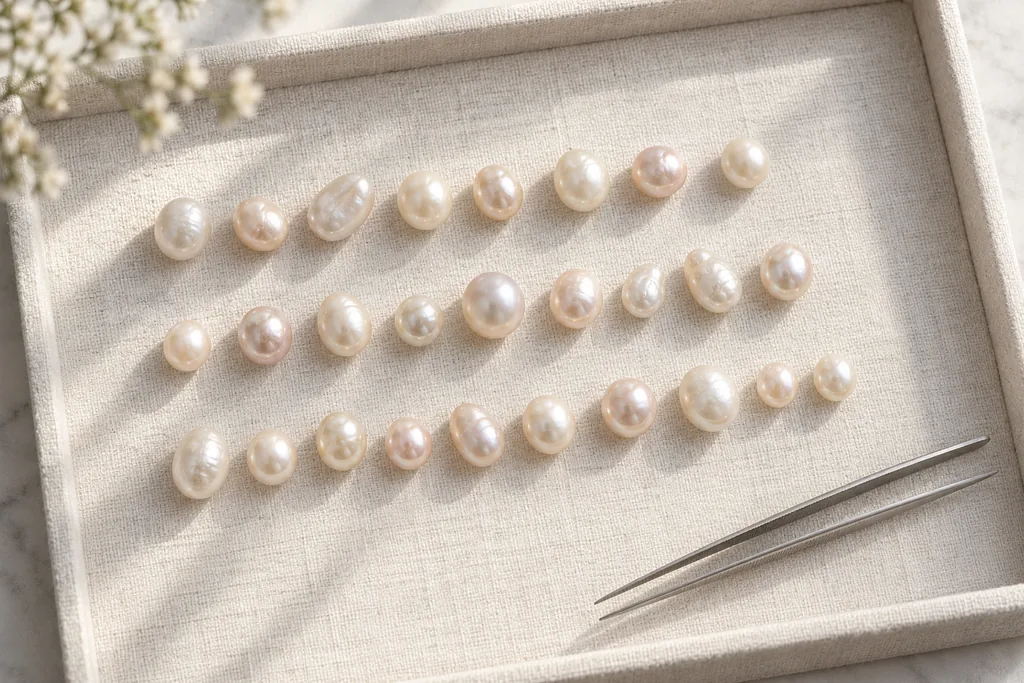
At harvest, the mussel is opened and the pearls are removed. Their shapes, sizes, colors and surfaces vary. The next part of the journey starts with looking closely.
Every pearl brings
something different.
After cleaning, pearls are sorted and matched. A pair of earrings calls for harmony. A baroque pendant can celebrate a shape all its own.
- LusterHow light meets the surface
- Shape & sizeThe silhouette and proportions
- Color & surfaceTone, character and natural marks
- MatchingHow pearls work together
From a pearl to a piece.
Design brings the parts together. The exact steps depend on the jewelry: a strand, a pair of studs and a pendant each ask for different details.
Prepare with purpose.
Pearls may be drilled for stringing or mounting. Hole position and size are chosen for the intended construction.
Bring it together.
Match a pair, string a strand, or fit a pearl to a setting. Proportion, attachments and finish shape the piece.
Ready for the journey.
Check the finished piece and protect it for handling and transport. Packaging is the last layer before it reaches its wearer.
Process illustrations show general jewelry-making steps. Pearls can also undergo treatments such as bleaching, dyeing or luster enhancement; applicable information belongs with the specific product. Illustrations do not specify SUHA’s facilities, packaging or product treatments.
The third chapter / Into the world
09 / A place where journeys meetFrom Zhuji.
To a world of possibilities.
In Zhejiang, China, Zhuji’s Shanxiahu connects pearl suppliers, processors, designers and buyers. A local network with a global reach.
A meeting place for pearls.
Pearls grown in different regions can enter the trading and processing networks around Zhuji. Being purchased here does not mean a pearl was farmed here.
Many ways to reach the wearer.
Wholesale, retail and cross-border commerce connect these networks to markets including the United States. Fulfillment routes and timing depend on the seller and order.
The next chapter is yours
A long journey.
A personal beginning.
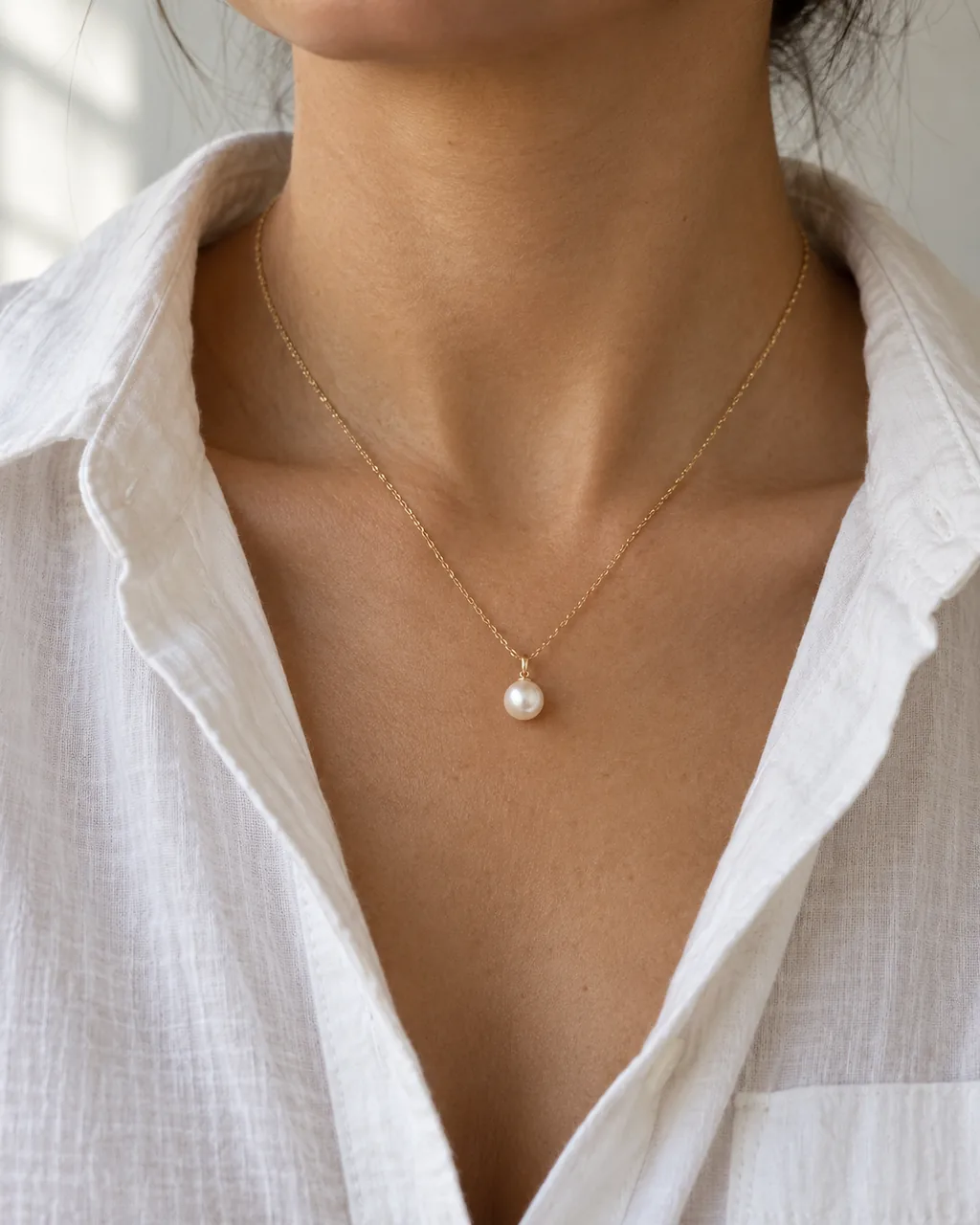
A gift. An everyday favorite. A little reminder of someone, or somewhere. The most personal part of a pearl’s story starts when you make it your own.
About this story & its illustrations
This is an educational overview of a typical Chinese freshwater cultured-pearl journey. Species, farming methods, treatment, manufacturing and distribution vary. It is not an account of the origin or production history of every SUHA product.
All photographic-style images on this page are AI-created editorial concepts. Original diagrams simplify biological structures and production processes. Neither is documentary evidence of SUHA farms, suppliers, facilities, staff or products. Check individual product information and current shipping policies for your purchase.
Further reading & sources
- Dalian Ocean University: freshwater pearl mussel larvae and host fish (2017)
- GIA: natural and cultured pearls
- GIA: pearl formation, research and treatments
- Zhejiang: Zhuji’s pearl industry and international trade (2023)
- Map geometry: Natural Earth, public domain
Editorial review: October 2026. Industry examples are explanatory; they are not current stock, sourcing or delivery guarantees.